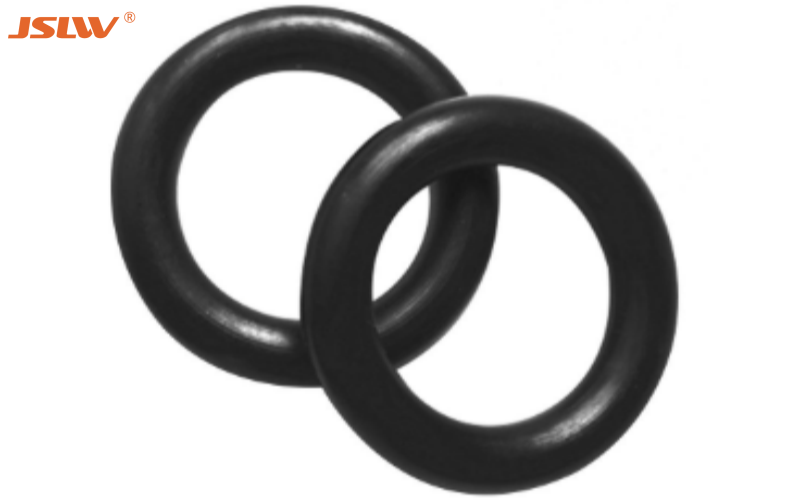
Rubber O-rings, despite their simple structure being merely a circular ring, are indispensable cornerstones in modern engineering. It silently hides at the junctions of countless devices, from sophisticated spacecraft to everyday car engines, from complex hydraulic systems to household water purifiers, everywhere.
1.Core Function: Sealing
This is the most basic and primary function of an O-ring. It works by creating a controlled deformation between two or more components to block or control the flow path of a fluid (liquid or gas). This can be specifically divided into static and dynamic sealing.
Static Sealing is used between the mating surfaces of parts that have no relative movement. Common applications include end cap sealing for hydraulic cylinders or gearbox housings, flange sealing for pipe connections, and thread sealing in screw plugs or pipe threads to prevent leakage through the gaps.
Dynamic Sealing is used between parts that have relative motion. Typical applications include reciprocating motion seals, such as piston and piston rod seals in hydraulic and pneumatic cylinders, where the O-ring provides continuous sealing as components move back and forth. They are also used for low-speed rotary motion seals on mixer shafts or certain drive shafts.
2.Auxiliary and Derived Functions
Dust and Contaminant Exclusion
Description: Prevents external contaminants like dust, dirt, and moisture from entering a precision or clean system.
Application Examples: Dust boots on automotive shock absorbers, seams in electronic device housings, protective covers on food machinery.
Cushioning and Damping
Description: Utilizes the elasticity of rubber to provide slight cushioning, vibration damping, or sound insulation between components.
Application Examples: In some precision instruments or household appliances, O-rings can be used to absorb minor vibrations and prevent noise from part collisions.
Positioning and Spacing
Description: In some designs, O-rings can be used to maintain the relative position of two parts or provide a fixed gap.
Application Examples: In the focusing mechanism of telescopes or the assembly of some knobs, O-rings can provide appropriate damping and a sense of positioning.
3.Summary of O-Ring Advantages
The reason O-rings are so widely used is due to their significant advantages:
Simple Structure, Low Cost: A simple toroidal shape makes them inexpensive to mold and mass-produce.
Easy Installation: Groove designs are usually simple, making installation and maintenance easy.
Compact Size: Requires minimal installation space, conducive to equipment miniaturization.
Low Friction Resistance : With the correct rubber material and groove design, they can be suitable for dynamic sealing applications.
4.In conclusion
In summary, the core function of a rubber O-ring is to provide reliable sealing under both static and dynamic conditions, while also incorporating auxiliary functions such as dust exclusion and cushioning. It is an indispensable basic component in modern industry, especially in fields like hydraulics, pneumatics, automotive, aerospace, medical devices, and consumer goods.