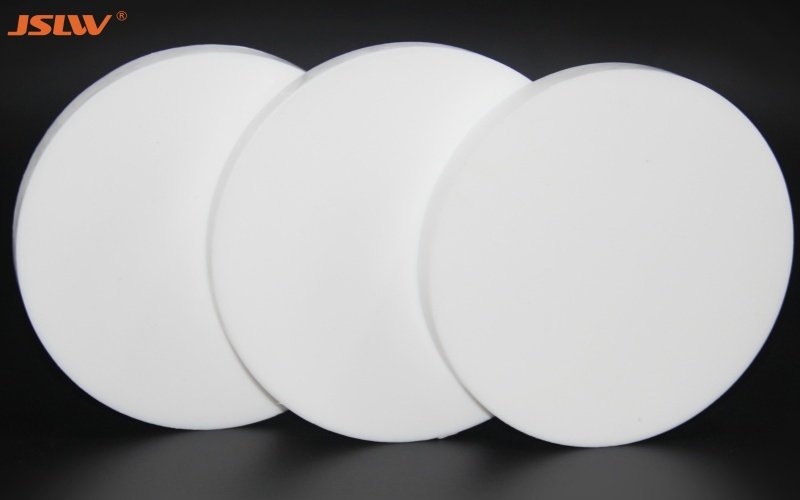
In industrial manufacturing and laboratory equipment, PTFE round sheets—also known as polytetrafluoroethylene (PTFE) plates—are widely favored for their excellent corrosion resistance, high and low-temperature tolerance, low friction coefficient, and superior insulation properties. However, have you ever felt confused when selecting them?
1.Clarify Usage Requirements: Temperature, Medium, and Pressure
First, you need to understand the environment in which the PTFE round sheet will be used:
Temperature Range: PTFE can generally operate within a range of -200°C to +260°C. However, if the temperature is near the limits, verify the sheet’s thermal stability and whether it contains temperature-resistant reinforcing materials.
Contact Medium: While PTFE is resistant to most chemicals, it’s still necessary to confirm compatibility with specific acids, alkalis, or solvents (e.g., molten alkali metals or high-temperature fluorides may affect it).
Pressure and Load: Pure PTFE is relatively soft and has low mechanical strength. For applications with high mechanical pressure or frequent friction, consider reinforced sheets (e.g., with added glass fiber, graphite, etc.).
2.Focus on Sheet Specifications: Dimensions and Thickness
Select the appropriate physical specifications based on your application:
Diameter and Thickness: Measure the dimensions required for the installation location, leaving some margin. Common thicknesses range from 1mm to 50mm. Thicker sheets offer better rigidity but lower machining flexibility, while thinner sheets are easier to cut.
Shape and Machining Requirements: If post-machining such as turning, drilling, or cutting into complex shapes is needed, choose sheets with uniform internal structure and no bubbles to ensure machining precision.
3.Identify Material Quality: Pure vs. Filled Materials
PTFE sheets are divided into pure PTFE and filled/modified PTFE, with significant performance differences:
Pure PTFE: Offers the best chemical stability and electrical insulation, making it suitable for high-purity or highly corrosive environments (e.g., semiconductors, chemical sealing).
Filled PTFE: Typically includes additives like glass fiber, carbon fiber, or molybdenum disulfide to improve hardness, wear resistance, and creep resistance. This type is suitable for mechanical parts, guide rail gaskets, and other load-bearing applications. When selecting, confirm the filler ratio and whether it affects corrosion resistance.
4.Examine Production Processes and Standards
High-quality PTFE round sheets rely on standardized production processes:
Molding or Hydraulic Processes: Molded sheets have higher density and more stable performance, while hydraulically pressed sheets are larger but may have slightly lower density. Prioritize manufacturers that follow standard processes (e.g., GB/T 17737).
Surface and Internal Quality: Check whether the sheet is flat, uniformly colored, and free of cracks, impurities, or porous structures. Request material reports from suppliers (e.g., temperature resistance tests, chemical resistance data).
5.Choose a Reliable Supplier
The supplier’s technical support and after-sales service are equally important:
- Credentials and Reputation: Check if the company has relevant certifications (e.g., ISO, FDA certifications for food or medical applications) and refer to industry reviews.
- Sample Testing: Before bulk purchasing, request samples for testing in actual conditions to verify whether their performance meets expectations.
- Technical Support: A good supplier can provide selection advice, machining guidance, and help optimize usage plans.
Conclusion
Choosing the right PTFE round sheet isn’t difficult—the key lies in systematically analyzing your needs and matching them with material properties. Start by understanding the operating environment, clarifying temperature, medium, and pressure requirements. Then, determine dimensions and thickness based on installation and machining needs. Next, choose between pure or filled materials according to mechanical or chemical performance requirements. At the same time, ensure quality by examining production processes and supplier credibility. Remember, there is no “best” material, only the “most suitable” solution. Taking the time to make the right choice upfront can enhance equipment reliability and save on long-term maintenance costs.